PROPORTION:
The homotecias are joined with an interesting topic
called the proportion. More than joined to the topic is a property of the
homotecias, without proportion there’s no homotecia. So, what is the
proportion?
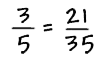
The proportion: A proportion is a name we give to a
statement that two ratios are equal. It can be written in two ways:
- two equal
fractions,

Or,
- a:b
= c:d
To check that
between two ratios is a proportion you can do by many ways, there’s exactly 10
ways sometimes are easiest than other ways. The easiest way to find the
proportion is to multiply the extremes and the medios it had to show the
same result.
When two ratios
are equal, then the cross products of the ratios are equal.
 SIMILARITY:
Two geometrical
objects are called similar if they both have the same shape. More precisely,
either one is congruence. When there are two geometrical objects and don’t change
his angles it calls similarity. It does not mean that the size had to be the
same, it would be equally. In basic words it can change the form and the
direction of the object but it cannot change his angles.
CARTESIAN
COORDINATE SYSTEM:

A Cartesian coordinate system specifies each point uniquely in a plane
by a pair of numerical coordinates, which are the signed distances from the
point to two fixed perpendicular directed lines, measured in the same unit of
length. Each reference line is called a coordinate axis or just axis of the
system, and the point where they meet is its origin, usually at ordered pair (0,
0). The coordinates can also be defined as the positions of the perpendicular
projections of the point onto the two axes, expressed as signed distances from
the origin.
To find the coordinates you have to read the numbers inside the
parenthesis, like: (1, 8)
You had to find the one in the (X) side, the horizontal side. Then you
had to find the8 in the (Y) side, the vertical side.
It can be positive numbers ore negative numbers also, it depends on the
symbol.
POSTED BY: NICOLAS
GARCIA RUBIANO. 7B

No hay comentarios:
Publicar un comentario